

Consciousness Fiction
A Framework for Storytelling Centered on Consciousness Evolution

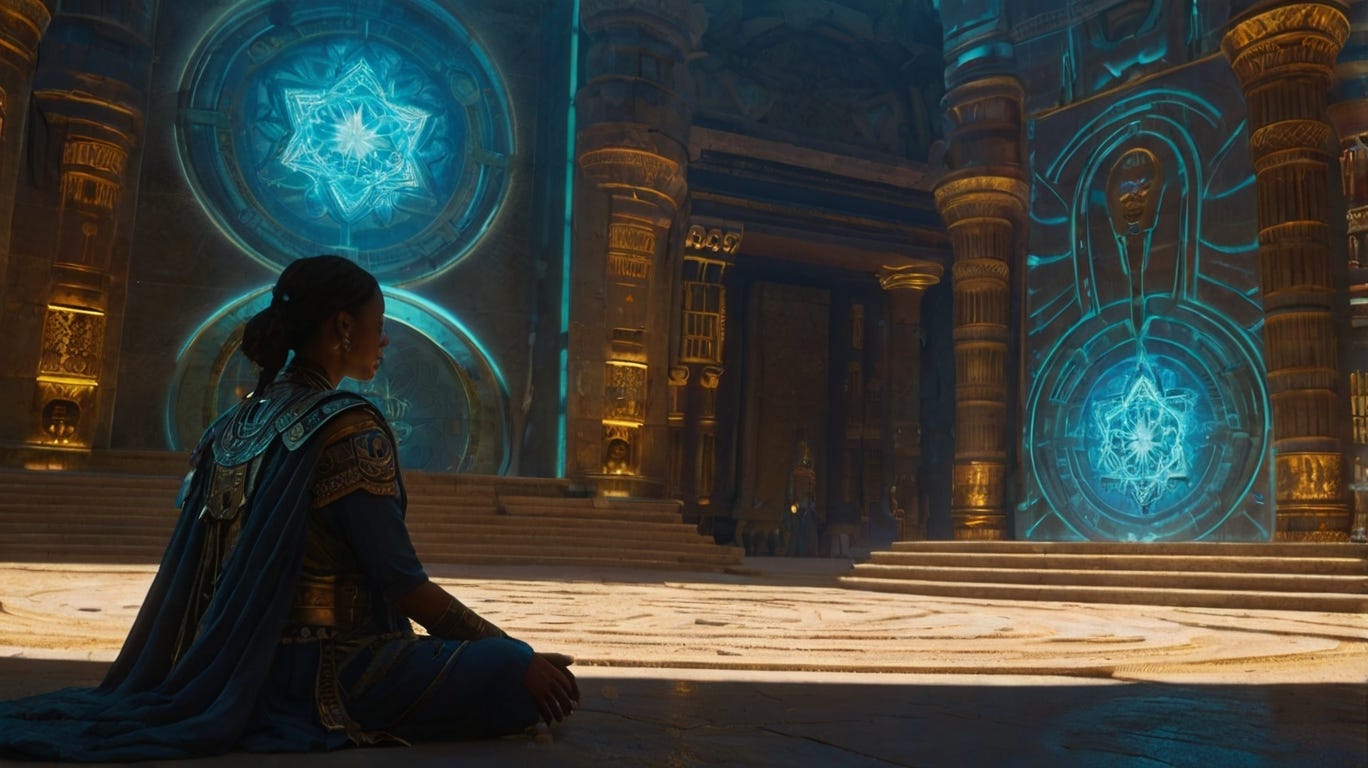
We are obsessed with the evolution of our tools.
Look at our favorite visions of the future:
Stars wrapped in Dyson shells. Neural links stitching our brains to the cloud. Sleek hulls breaking the light-speed barrier. We have imagined every possible upgrade of the silicon chip and the steel turbine.
Now look at the people living in those futures.
They’re almost always us.
21st-century humans, unchanged at the core. Driven by the same anxieties. Limited by the same five senses. And trapped in the same reactive nervous systems. The only difference is that they happen to be holding faster iPads.
We rarely question this.
We assume that while technology evolves, consciousness does not. That awareness itself is fixed. Finished. Already at its final version.
But this is actually a strange belief.
Across history, entire cultures worked from the opposite assumption: that human consciousness is unfinished, trainable, and capable of profound transformation. Daoist internal alchemy. Vedic sciences. And other contemplative traditions across continents. All treated inner development as a long arc, not a given.
Yet our stories almost never go there.
They imagine futures where everything evolves. Except the mind doing the imagining.
The Hardware Paradox
We have mapped the stars, but misplaced the map to ourselves.
This is the central blind spot of modern speculative fiction.
We picture civilizations with god-like tools, yet populated by beings who remain psychologically and perceptually immature. Characters who can bend spacetime but cannot reliably regulate their own attention, emotions, or inner states.
In our stories, bodies are replaced with machinery. Eyes with sensors. Limbs with alloys.
But the observer behind the eyes—the structure of awareness itself—stays the same.
Not because consciousness lacks potential. But because we assume there is nowhere left for it to go.
And that assumption shapes everything.
Look closely at our most advanced tools and a pattern appears. Most of them are external compensations for unexamined limits:
Devices that see farther than eyes
Machines that move faster than legs
Networks that amplify voices instead of clarity
We are extending ourselves outward while leaving the inner structure untouched.
The result is not evil or foolish. It is simply constrained. Our technology reflects the narrowness of the minds that imagine it. Not by intent, but by omission.
Historically, this kind of constraint is a signal.
Genres emerge when imagination reaches the edge of what it knows how to picture.
Science fiction arose when humanity sensed that the physical world was open to conquest. It offered blueprints for the external. Visions that scientists and engineers would spend a century making real.
And we now live inside those blueprints.
Our outer world resembles the future we once dreamed of. But our inner world does not. The gap is becoming impossible to ignore: powerful systems guided by fragile psychology, planetary-scale tools steered by untrained awareness.
Building further outward no longer solves this. It magnifies it.
A faster vehicle means little if no one knows how to steer.
That is why the next frontier cannot be another machine.
It must be the evolution of the one using it.
And this is where a new kind of storytelling becomes necessary.
Not to imagine better tools. But to explore better modes of being.
Not only to ask what we can build. But what kind of consciousness would be capable of wielding what we’ve already built.
Consciousness Fiction (Con-Fi)
For a long time, we’ve lacked the language to tell certain stories without defaulting to magic or religion.
Stories about inner transformation. Stories about expanded perception. Stories where the mind itself evolves.
When these changes appear in fiction, they are usually framed as miracles, gifts, or metaphors. Events that happen to characters rather than skills they develop. The inner world is treated as a mystery, not a domain of mastery.
Consciousness Fiction begins with a different assumption:
It treats consciousness as trainable, progressive, and causal.
Just as science fiction extrapolates from physics, biology, and technology, consciousness fiction extrapolates from what could be called the internal sciences: disciplined systems that study perception, awareness, attention, and identity as things that can be refined over time.
In a Con-Fi story, a higher state of awareness is not a miracle. It is the result of practice.
If a character perceives more of reality, inhabits multiple layers of experience, or operates from a fundamentally different mode of being, that change has structure. It has prerequisites. It has consequences.
It is engineered—internally.
And we already accept this logic in science fiction: When a starship crosses light-years in seconds, we don’t call it magic. We call it engineering. We accept it because the story treats it as the outcome of mastered laws, not divine exception.
Consciousness Fiction applies the same narrative discipline inward:
The laboratory becomes internal
The technology becomes psychological, perceptual, and existential
The frontier is no longer space, but the one exploring it
This isn’t a new idea. It’s a neglected one.
Across cultures and centuries, humans have mapped the inner world with surprising precision. Different languages. Different symbols. But a recurring pattern: staged development, expanded perception, altered relationships to self and reality.
These traditions are often shelved as mythology or belief. But read carefully, they behave less like folklore and more like early field manuals—attempts to describe consciousness as something navigable rather than static.
Consciousness Fiction doesn’t retell these traditions. It extrapolates from them.
It asks what kind of stories emerge when inner development is treated with the same seriousness, rigor, and imaginative reach that science fiction once applied to the external world.
In that sense, Con-Fi isn’t about escaping reality.
It’s about finally including the part of reality we’ve been leaving out.
The Core Components of Consciousness Fiction
To build a Con-Fi world, we must first understand how it works. These 6 components form its structural DNA. They are drawn from the practices and insights of human civilizations across history, distilled into functional principles. Think of them as the technical standards of inner engineering, the scaffolding on which the genre is built.
1. Internal Technology
Consciousness is a domain of applied skill. In Con-Fi, spiritual practices (e.g., meditation, breathwork, energy cultivation) become repeatable protocols. They are technologies of the self, producing consistent, measurable outcomes rather than miracles.
So, a character might:
Restructure matter through focused intent
Navigate subtle planes (e.g., the astral, causal, or spiritual) like trained instruments
Internal mastery is deliberate, learnable, and causal.
2. Metaphysical Principles
Stories are grounded in predictable laws of consciousness, not metaphorical abstractions. Ancient teachings provide these rules, treated as reliably as physics. They explain how awareness interacts with reality.
A character’s abilities follow principles such as:
Mentalism: All is mind. Reality bends because perception structures it.
Vibration/Octaves: Matter is energy at different frequencies. By tuning themselves, characters perceive or influence layers of reality others cannot.
These principles give Con-Fi its internal logic.
3. Trans-Dimensional Societies
Some civilizations in Con-Fi have evolved beyond biological bodies. They inhabit multiple densities of consciousness, interacting with each other and the environment in fundamentally different ways.
For instance:
Beings living as pure light or energy forms
Collective intelligences navigating astral or causal realms as primary reality
The social fabric itself is structured around these states of awareness.
4. Speculative Exploration
Con-Fi is a thought experiment on the consequences of spiritual evolution. It asks: What happens when consciousness develops at scale? How does life, culture, and governance shift when perception expands?
So, examples could be:
A society where telepathy makes deception impossible
A civilization attuned to high-frequency states, reshaping their environment and ethics
Exploration is always systemic: changes in mind ripple outward.
5. Themes of Consciousness Evolution
Conflict moves inward. Challenges are no longer just external. They emerge from growth itself. Characters must shed lower-density patterns while navigating the responsibilities of expanded awareness.
This could be, for example, illustrated through:
Maintaining higher states of consciousness amid lower-density environments
Deciding whether and how to apply internal technologies to influence others
Ethics, discipline, and self-mastery become narrative stakes.
6. Speculative Worldbuilding
In Con-Fi, the environment is not a backdrop. It is an extension of consciousness. Worlds respond to perception, emotion, and intent. Matter and space are interactive, malleable, and alive.
This could look like this:
Landscapes that shift color or geometry based on collective emotional states
Architecture that grows or reshapes itself according to the focus and intent of its inhabitants or architects
The boundary between internal and external reality dissolves, creating worlds that are both immersive and causally coherent.
The Visual Language of Consciousness Fiction
In Con-Fi, visuals do more than decorate. They express consciousness itself. Every design choice is a reflection of awareness in action. Characters, architecture, and environment are not merely objects. They are interfaces of internal states, legible to anyone who knows the rules.
1. Characters
Characters are living instruments of consciousness. Their appearance, posture, and presence communicate density, mastery, and evolution:
Physical form reflects internal development: subtle shifts in proportion, stance, or balance reveal levels of awareness.
Internal technologies manifest externally: light fields, layered energy, or subtle flows make invisible mastery visible.
Interaction with matter and space shows causality: a gaze that bends objects, gestures that leave trails of energy, movements that influence the environment.
Design principle: Every character should communicate state of being, not just occupation or archetype. The viewer should sense the evolution of consciousness before action or dialogue.
2. Architecture
Built spaces are extensions of the observer’s mind. Walls, halls, and structures respond to intention, attention, and harmony:
Forms grow, shift, and adapt dynamically, reflecting mastery or disharmony.
Architectural elements encode consciousness principles: fractals for vibration, layered planes for ascension, proportions that mirror balance and resonance.
Spaces are functional metaphors: interiors and exteriors are tools to express perception, discipline, and evolution.
Design principle: Buildings are active participants in the narrative. They must feel like living systems that reflect the consciousness of those who inhabit them.
3. Environment
Landscapes and objects are alive, shaped by perception, energy, and collective awareness:
Terrain, flora, and sky shift in color, texture, and geometry according to emotional or spiritual frequency.
Visual cues indicate states of awareness: clarity, density, resonance, or alignment are expressed through environmental cues.
Light and color are primary vocabulary: subtle hues, gradients, and intensity communicate energy, density, and consciousness. The environment becomes a canvas for perception itself.
Design principle: The world is interactive. It tells the story of the consciousness that inhabits it. What is seen, felt, and sensed in the environment is a direct reflection of inner evolution.
Why Now? The Post-Materialist Shift
We are moving through a massive transition in how we dream.
And our stories have always mirrored the trajectory of our collective focus. What we fear, what we value, what we believe is possible eventually shows up in our fiction.
For centuries, we and our stories have been stuck in a materialist loop. Obsessed with the mastery of the “object.”
But the audience is shifting.
We are tired of nihilistic dystopias where the only future is a shinier version of our current problems. Tired of worlds where the tools evolve but the inner life does not. Where change remains individual, isolated, incompatible with the societies meant to hold it.
We are craving stories of ascension, harmony, and agency over our own souls.
That is why the progression is clear:
Phase 1: Survival (External Mastery)
We focused on the physical world. We imagined how technology might destroy us or how we might survive the machine (e.g., Blade Runner, The Matrix).
Phase 2: Management (External Harmony)
Our focus shifted to the social world. Worlds where technology is no longer the enemy, but something to be stewarded. We imagined how we might manage our resources and environments to create a sustainable “Utopia” (e.g., Solarpunk).
Phase 3: Transformation (Internal Mastery)
The focus turns inward. We move from mastering the object to mastering the subject. We stop asking how to change the world and start asking how the self creates and influences it. We begin to imagine how inner technology might evolve the human being itself. This is where Consciousness Fiction belongs.
We have already seen early hints of this shift in films like Arrival or Everything Everywhere All At Once. Stories where the “climax” isn’t a battle, but a shift in the protagonist’s perception. Where resolution comes through understanding time differently, relating differently, being differently.
These stories don’t feel like anomalies. They feel like previews.
They point to a missing genre.
Just look around. We are already living in the high-tech future our ancestors fantasized about: Instant communication. Global computation. Machines that learn. In time, we will likely achieve cleaner cities, longer lives, even interstellar reach.
But a question remains. And it grows louder as our tools improve:
What happens when there’s nothing left to build on the outside?
What happens when the civilization’s hardware approaches mastery, but the user—the human being—still runs on the same primitive software of fear, reactivity, and limited perception?
At that point, building bigger machines stops being progress.
The only meaningful frontier left is internal.
Consciousness Fiction is an attempt to model what comes next. To imagine worlds shaped by evolved awareness, not just advanced tools. To explore what kind of beings might be capable of wielding the futures we are already constructing.
Because once the stars are mapped, attention eventually turns inward.
And we’ll realize that the greatest mysteries were always the ones behind our own eyes.
This work is not a conclusion.
It’s a starting framework. A set of initial standards, meant to be tested, expanded, and reimagined.
If this genre is to exist, it will not belong to one voice. It will belong to those who feel the pull of the internal frontier. And are willing to build worlds that take it seriously.
We’ve seen what happened to our collective culture when we started dreaming about advanced science and tech.
Imagine what could happen when we start dreaming about advanced consciousness.
Until the next page,
— Zhenya